


Preventing Deep Vein Thrombosis (DVT) When You Travel

Preventing DVT on Long Trips: Evidence + The Ultimate Infrared Compression Sock
Long periods of sitting can increase the risk of blood clots in the legs (DVT). The absolute risk is small for most travelers, but higher with additional risk factors. Use these simple, evidence‑based steps and consider travel socks that combine graduated
compression with KYMIRA infrared technology.
Evidence‑based travel checklist:
- Move every 1–2 hours; choose an aisle seat when you can.
- Do seated calf pumps and ankle circles; avoid tight garments at the knee crease.
- Fluid intake is important – research shows us that dehydration increases blood viscosity, so stay hydrated ideally with ion-containing drinks and it will help to reduce blood viscosity.
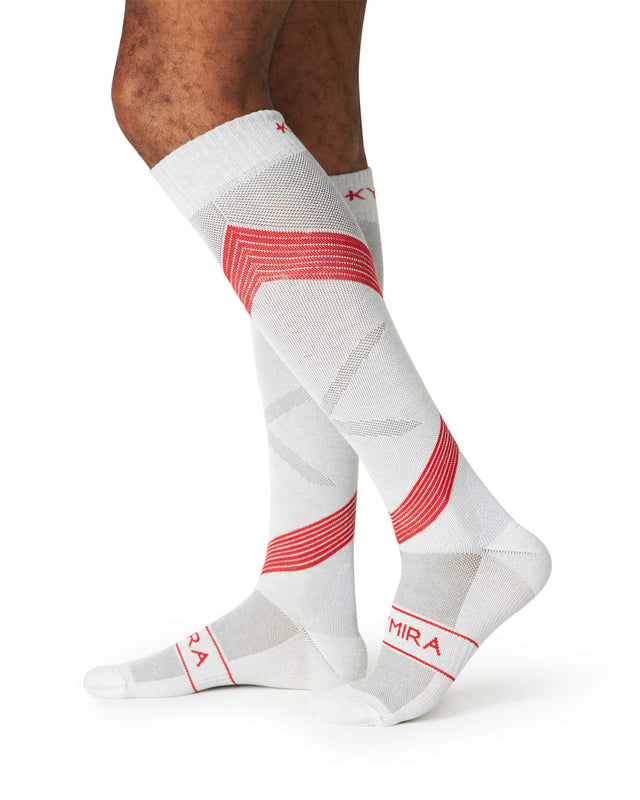
- Wear compression infrared socks / stockings to support blood circulation and vasodilation passively during sitting for long periods.
What is DVT?
Deep vein thrombosis is a condition where blood clots form in the blood vessels (usually in the legs). If part of the clot breaks off and travels through the bloodstream it can cause problems in other areas such as the lungs.
In extreme cases, DVT can be fatal, so you can understand why for those suspectable to the condition, deep vein thrombosis is a very real concern.
The good news is that you can help to avoid DVT by taking a few basic steps. It's a condition that is sometimes caused by lifestyle factors such as sedentary behaviour and long-distance travel (travel over 4 hours doubles the risk of developing DVT) [1]. Both reduce the rate of blood flow, so help to create the conditions whereby clots can form.
Here's how to help avoid DVT using infrared technology, even when you're travelling.
Compression and DVT
The official NHS advice regarding DVT and travel is to wear compression socks and move as often as possible [3]. The KYMIRA socks combine both the infrared technology with compression, so you get the best of both worlds. The evidence collected from other studies also recommend compression stockings for avoiding DVT when travelling [4].
If you know you're going to be embarking on a long journey – especially in the air, dress accordingly. If you're at a particularly high risk of deep vein thrombosis (over 60, smoker, obese etc) then it'd make sense to wear KYMIRA garments even on long car or train journeys.
How movement helps
Exercise is one of the most effective circulation boosters there is, so it comes as no surprise that the research around movement and reduction of DVT risk is strong [5]. You don't have to exercise to a particularly high intensity – especially if you're wearing the KYMIRA garments. The effects of the movement and the infrared compound, meaning there's additional benefit.
Simply going for a walk, a gentle bike ride, a gym workout etc are more than sufficient to raise the pulse rate, therefore improve your circulation and significantly reduce your risk of deep vein thrombosis.
The power of Compression & Infrared Combined Technologies for DVT Prevention
Infrared compression socks go beyond standard compression by stimulating nitric oxide production, improving vasodilation, and enhancing transcutaneous oxygenation—mechanisms clinically shown to accelerate circulation and reduce inflammation—making them even more effective at lowering DVT risk during travel compared to compression alone.
This draws directly from KYMIRA’s clinically documented outcomes, including:
- Increased nitric oxide production (improves blood flow and oxygen delivery)
- Enhanced vasodilation and microcirculation
- Improved tissue oxygenation and reduced inflammation

KYMIRA Protocols
Infrared Priming: Wear ≥30 min pre-travel, 90 mins for optimal blood circulation and vasodilation effects. Wear for the entire duration of travel.
Try KYMIRA Infrared Compression Socks


References
[1] https://www.ncbi.nlm.nih.gov/pmc/articles/PMC2020806/
[2] https://onlinelibrary.wiley.com/doi/full/10.1002/advs.201801122
[3] https://www.nhs.uk/conditions/deep-vein-thrombosis-dvt/
[4] https://www.ncbi.nlm.nih.gov/pmc/articles/PMC6457834/
[5] https://pubmed.ncbi.nlm.nih.gov/17697136/
[6] https://www.nhs.uk/live-well/healthy-body/prevent-dvt-when-you-travel/
[7] https://www.ncbi.nlm.nih.gov/pmc/articles/PMC2949997/
[8] https://www.ncbi.nlm.nih.gov/pmc/articles/PMC5699925/
[9] https://www.ncbi.nlm.nih.gov/pmc/articles/PMC5024560/
[10] https://online.boneandjoint.org.uk/doi/full/10.1302/0301-620X.87B8.15680
[11] https://www.otsuka.co.jp/en/nutraceutical/about/rehydration/researchlab/studyresults05.html