The Sleep Blueprint:
Thermoregulation & Circulation for Deep Sleep

Steve Hoyles
In elite sport, sleep is non-negotiable. It’s the foundation of recovery, adaptation, and consistent performance.
For strength and conditioning coaches, sports scientists, and athletes chasing
marginal gains, the difference between good sleep and deep, restorative sleep often comes down to two physiological levers most people overlook: thermoregulation and circulation.
Master these, and you don’t just fall asleep faster, you spend more time in slow-wave
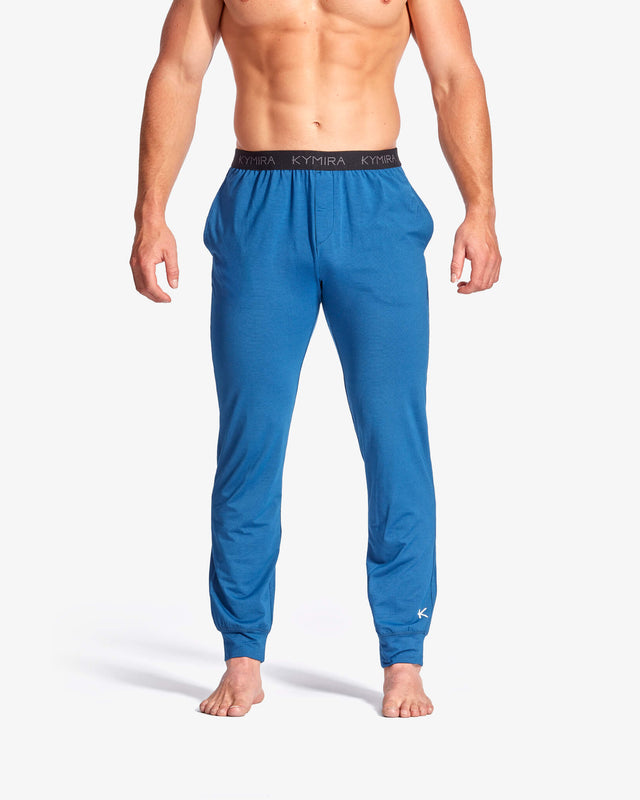
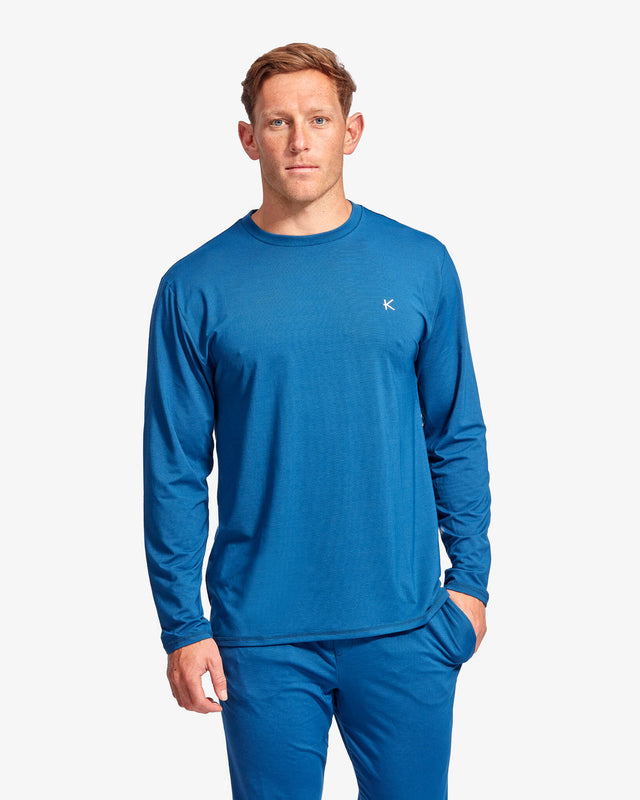
sleep, accelerate overnight repair, and wake up measurably fresher. Here’s the science, and how KYMIRA sleepwear optimises sleep, turning it into a practical, evidence-based edge.
Thermoregulation: The Trigger for Deep Sleep
Sleep initiation is biologically coupled to a controlled drop in core body temperature. The hypothalamus detects this decline and flips the switch into NREM sleep. Disruption of that process (often through residual exercise heat, poor environmental control, or impaired heat dissipation) results in fragmented sleep, reduced slow-wave sleep (N3), and slower recovery.
Research consistently shows that the body achieves optimal sleep architecture when it
can lose heat efficiently. In warm conditions, wakefulness increases and both slow-wave and REM sleep decline; in cooler settings, the body can more readily down-regulate core temperature, promoting deeper N3 stages. [1]
A 2024 study titled ‘Enhanced conductive body heat loss during sleep increases slow-wave sleep and calms the heart’ demonstrated that enhanced conductive body-heat loss during sleep significantly increased time in N3 (+7.5 min on average) and lowered heart rate, with the greatest benefits linked to the core-to-skin temperature gradient rather than absolute core temperature alone. [2]
For athletes, this matters acutely. Post-training metabolic heat lingers, and many compete or train in environments that challenge natural cooling. The result? Delayed sleep onset, more micro-arousals, and blunted overnight growth-hormone release, all of which slow muscle repair and glycogen replenishment.
Circulation: The Engine of Overnight Repair
While thermoregulation puts the athlete into deep sleep, circulation keeps the repair work happening once they’re there.
Efficient blood flow delivers oxygen and nutrients to fatigued muscle fibres, clears metabolic waste (lactate, inflammatory cytokines), and supports nitric-oxide-mediated vasodilation that keeps capillaries open and tissues oxygenated.
Poor peripheral circulation during sleep leads to localised discomfort, restlessness, and delayed clearance of exercise-induced inflammation - exactly what athletes experience as lingering DOMS or stiffness the next morning.
Studies in athletic populations link better vascular function to improved sleep quality and faster neuromuscular recovery. [3]
Nitric oxide (NO) is the key player. It relaxes vascular smooth muscle, widens capillaries, and increases tissue oxygenation. Anything that safely elevates NO during rest accelerates waste removal and cellular repair without requiring active movement.
KYMIRA Sleepwear: Clinically Proven to Optimise Both Temperature and Circulation
KYMIRA’s patented infrared fabric doesn’t rely on external power or cooling gels.
Instead, it embeds bio-ceramic minerals that absorb wasted body heat and ambient energy (up to 93%), convert it into far-infrared wavelengths, and reflect them into the tissues.
The biological response is rapid: within 30 seconds of wear, capillary flow and vasodilation are visibly enhanced under microscopy.
Thermoregulation benefits
KYnergy fabric warms 63% faster in cold conditions and dries 65% quicker in heat,
creating a stable microclimate that supports the natural core-temperature drop required for deep sleep.
Circulation benefits
Far-infrared stimulation upregulates endothelial nitric-oxide synthase, accelerating the conversion of L-arginine into NO. This increases vasodilation, increased transcutaneous oxygen pressure (tcPO₂+20 % after 70–90 minutes), and improved microcirculation — exactly the conditions needed for overnight tissue repair.
Independent clinical data back the outcomes.
In an athlete cohort, wearing KYMIRA infrared sleepwear produced a 15.9%
improvement in objective sleep quality, alongside 15.8% less fatigue and 13.6%
reduced soreness.
The same study also showed accelerated neuromuscular recovery, superior countermovement-jump height, take-off velocity, and modified reactive strength
index at 24 and 48 hours post-exertion compared with placebo. [4]
Full details of the clinical research are available on the KYMIRA Science page.
Game-Ready Faster: The Athlete Pay-Off
Combining the impact of enhanced circulation and thermoregulation, athletes experience optimised sleep. Whilst that sounds like a vague promise, here are the
scientifically proven benefits of infrared-enhanced sleep and recovery…
- Faster transition into deep N3 sleep
- Accelerated clearance of metabolic by-products
- Reduced inflammation and muscle stiffness
- Earlier return to peak neuromuscular performance (often within 24–48 hours instead of 72+)
The net result for athletes is that they recover better and faster, train with higher quality the next day, and stay consistently game ready. No extra ice baths, no complicated protocols, just pull on the sleepwear and let the fabric do the work.
For travelling teams and athletes, this immediate improvement in recovery elongates the window in which they can recover.
The Bottom Line
Sleep isn’t a passive activity; it’s an active recovery window that can be optimised.
By targeting the precise physiological pathways of thermoregulation and
circulation, KYMIRA infrared sleepwear delivers a measurable performance edge
that aligns perfectly with the demands of modern sport.
Ready to upgrade your recovery blueprint? Explore the full range of KYMIRA sleepwear here and experience the difference science makes when you wear it to bed.
Sleep deeper. Recover stronger. Perform better. KYMIRA - Infrared Technology for the Serious Athlete.